
The sidewall of a modern car tyre is at first sight a confusing mixture of numbers, letters, codes and symbols that means absolutely nothing to the man in the street! And yet cracking the code reveals a whole load of useful, important and necessary information.
The tyre is arguably the most important safety component on a vehicle: only four patches of rubber, each no larger than the palm of a hand, connect the vehicle with the road surface. There are now many different tyres available for different applications and it is essential to buy the correct tyre - the details on the sidewall are essential in helping you make that choice.
According to TyreSafe, British motorists are woefully ignorant when it comes to the tyres on their cars. A recent poll conducted by the UK’s leading tyre safety organisation revealed that a staggering 80% of motorists did not know the legal minimum tread depth (1.6mm) and a large percentage have no idea what the symbols on a tyre sidewall denote. That means many do not know which size of tyre they need in the event of a replacement.
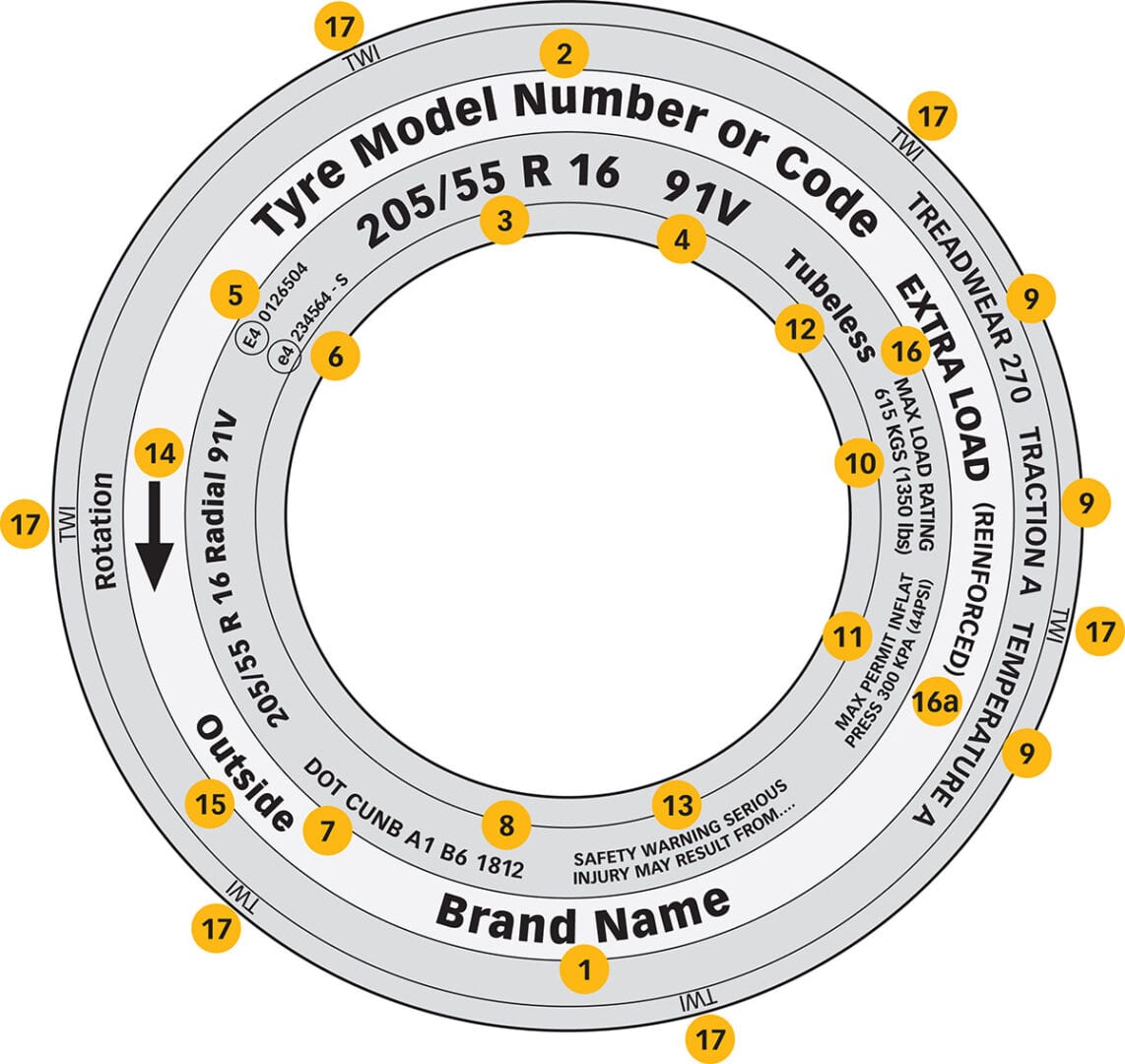
TyreSafe has produced a leaflet entitled Car Tyres and Your Safety, available to download from https://www.tyresafe.org, which contains an illustration and a simple explanation of what all the symbols, letters and numbers on a tyre’s sidewall actually mean. Here are the details to crack the code:
-
Manufacturer’s Name or Brand name This is the name of the company that manufactured the tyre and may include the range the tyre belongs to. e.g. Michelin, Toyo or Dunlop.
-
Model or Pattern Code The model/pattern refers to the range which the tyre belongs to. If it does not directly follow the manufacturer/brand name (item 1, above), it will be found on the opposite side of the tyre. e.g. X, Sport, Pilot or Eagle.
-
Tyre Size This is the nominal width of the tyre in millimetres, the height to width aspect ratio, what kind of design has been used and the rim diameter. The aspect ratio is the sidewall height as a percentage of the width of the tyre; in the image the sidewall’s height is 55% of 205mm. The design may be represented with a B, D or R and is an optional symbol. Most common is R, which stands for Radial. The rim diameter is the diameter in inches of the rim that the tyres are designed to fit. A-Series vehicles typically use 125/90R15 or 135/80R15 tyres - radial tyres that are 125mm or 135mm wide with sidewall heights that are 90% or 80%, respectively, of the widths (thus, 112.5mm and 108mm), and which fits on wheels with a diameter of 15".
-
Service Description A 2- or 3-digit number and, on typical cars, a single letter that, respectively, specify the tyre’s Load Index and Speed Rating. It is strongly recommended to fit tyres that have a speed capability and load index at least equal to those originally specified by the vehicle manufacturer. See the Load Index and Speed Rating tables below. In the image, the figure 91 (Load Index) denotes the tyre’s maximum weight capacity is 615 kg. The letter V (Speed Rating) indicates the tyre’s speed rating, in this case the tyre is suitable for cars capable of reaching a maximum speed of 149 mph.
-
ECE R30 Conformity Approval Number This indicates the tyres conform with European safety and environmental standards.
-
EEC Noise Approval Number This indicates the tyres do not exceed the maximum noise permitted by tyres of its size.
-
USA Dept of Transport Manufacturer’s Code
-
Date of Manufacture On tyres manufactured since 2000, this will be a 4-digit number where the first 2 digits represent the week in which the tyre was manufactured and the second 2 digits represent the year. "1812" in the image means the tyre was manufactured in week 18 of 2012. This is important as the age of a tyre can affect its performance. See below for more information about date codes.
-
USA UTQG Quality Grades (See below)
-
USA Maximum Tyre Loading (See below)
-
USA Maximum Tyre Inflation Pressure (See below)
-
Denotes Tubeless Construction
-
Safety Warning This will differ for each tyre and is an opportunity for the manufacturer to warn of any additional details you need to be aware of for optimum safety. For example, the dangers of under-inflation/overloading and the mounting of tyres together with the risk of severe over-inflation. This is particularly important as TyreSafe research shows that up to three quarters of cars on UK roads have incorrectly inflated tyres.
-
Direction of Rotation (Directional Tyres only) Directional tyres differ from standard tyres as they are designed to travel in one specific direction. If a tyre has this marking, it must be fitted on the correct side of the axle.
-
Outer/Inner Sidewall (Asymmetric Tyres Only) These tyres have different tread patterns on their inner and outer sides, offering improved performance, and must be fitted correctly. This label lets you know which side of the tyre is considered the “outer” or “inner” sidewall, so you know which side faces the vehicle.
-
Extra Load This denotes a higher load capacity than a standard car tyre. It may alternatively be labelled as “reinforced”. 16a is an alternative marking to “Extra Load”.
-
TWI – Tread Wear Indicators These are raised areas at the base of the tread grooves to serve as a visual warning of when the tyre is approaching or at the minimum legal limit.
9, 10 & 11 - These markings are required by North American legislation and have no significance in the UK & Europe.
More on Date Codes
The 4-digit date codes described above were introduced in 2000. Prior to that, 3-digit codes were used: the first 2 digits specified the month and the third digit the year. That system was replaced because the decade a tyre was produced could not be known. To mitigate this issue before the introduction of 4-digit dates, a triangular indentation was added after the three-digit code to signify the tyre was manufactured in the 1990s. Thus, 168◀ was manufactured in week 16 of 1998 but 168 (without triangle) could have been manufactured in 1988 or 1978.
Winter & All Season Tyres
Winter tyres have treads and rubber compounds designed to perform better than normal tyres in low temperatures and on surfaces covered with snow or ice. Historically, winter tyres were marked "M+S", meaning "mud and snow", but no performance tests are required to display the M+S marking; this is merely a self-certification from the manufacturer. Thus, "M+S" does not imply any sort of objective performance guarantee. Since 2018, EU regulations require winter tyres to meet minimum standards and such tyres must display the 3PMSF ("3 Peak Mountain Snowflake") symbol. This is the EU’s implementation of a previous UN regulation. Some countries mandate 3PMSF certified tyres must be used during the winter. Such countries may also specify a greater minimum tread depth for winter tyres. All Season tyres attempt to combine the benefits of summer and winter tyres and while their cold weather performance is typically less than dedicated winter tyres, many do meet the 3PMSF standard. At the time of writing, Michelin produces a 135/80R15 M+S tyre which looks good and is well regarded but it isn’t 3PMSF certified. The Maxxis AP2 All Season 135/80 R15 tyre is the only known 3PMSF-certified tyre produced in a standard A-Series size.
Tyre Load Index Table
Load is the maximum load per single wheel, not the vehicle’s gross weight (after all, that’s supported by 4 tyres).
| Load Index | Load kg | Load Index | Load kg | Load Index | Load kg |
|---|---|---|---|---|---|
50 |
190 |
75 |
387 |
100 |
800 |
51 |
195 |
76 |
400 |
101 |
825 |
52 |
200 |
77 |
412 |
102 |
850 |
53 |
206 |
78 |
425 |
103 |
875 |
54 |
212 |
79 |
437 |
104 |
900 |
55 |
218 |
80 |
450 |
105 |
925 |
56 |
224 |
81 |
462 |
106 |
950 |
57 |
230 |
82 |
475 |
107 |
975 |
58 |
236 |
83 |
487 |
108 |
1000 |
59 |
243 |
84 |
500 |
109 |
1030 |
60 |
250 |
85 |
515 |
110 |
1060 |
61 |
257 |
86 |
530 |
111 |
1090 |
62 |
265 |
87 |
545 |
112 |
1120 |
63 |
272 |
88 |
560 |
113 |
1150 |
64 |
280 |
89 |
580 |
114 |
1180 |
65 |
290 |
90 |
600 |
115 |
1215 |
66 |
300 |
91 |
615 |
116 |
1250 |
67 |
307 |
92 |
630 |
117 |
1285 |
68 |
315 |
93 |
650 |
118 |
1320 |
69 |
325 |
94 |
670 |
119 |
1360 |
70 |
335 |
95 |
690 |
120 |
1400 |
71 |
345 |
96 |
710 |
121 |
1450 |
72 |
355 |
97 |
730 |
122 |
1500 |
73 |
365 |
98 |
750 |
123 |
1550 |
74 |
375 |
99 |
775 |
124 |
1600 |
Tyre Speed Index Table
This chart shows the maximum speed for each tyre speed rating letter. The system is based on kilometres per hour (kmh), which is why the miles per hour (mph) increments vary.
| Speed Rating | mph | km/h | Speed Rating | mph | km/h |
|---|---|---|---|---|---|
A1 |
3 |
5 |
K |
68 |
110 |
A2 |
6 |
10 |
L |
75 |
120 |
A3 |
9 |
15 |
M |
81 |
130 |
A4 |
12 |
20 |
N |
87 |
140 |
A5 |
16 |
25 |
P |
93 |
150 |
A6 |
19 |
30 |
Q |
100 |
160 |
A7 |
22 |
35 |
R |
106 |
170 |
A8 |
25 |
40 |
S |
112 |
180 |
B |
31 |
50 |
T |
118 |
190 |
C |
37 |
60 |
U |
124 |
200 |
D |
40 |
65 |
H |
130 |
210 |
E |
43 |
70 |
V |
149 |
240 |
F |
50 |
80 |
W |
168 |
270 |
G |
56 |
90 |
Y |
186 |
300 |
J |
62 |
100 |
(Y) |
186+ |
300+ |
For further information, visit https://www.tyresafe.org
Based on an article first published in 2CVGB News, August 2008, with additional material added for the Handbook.